
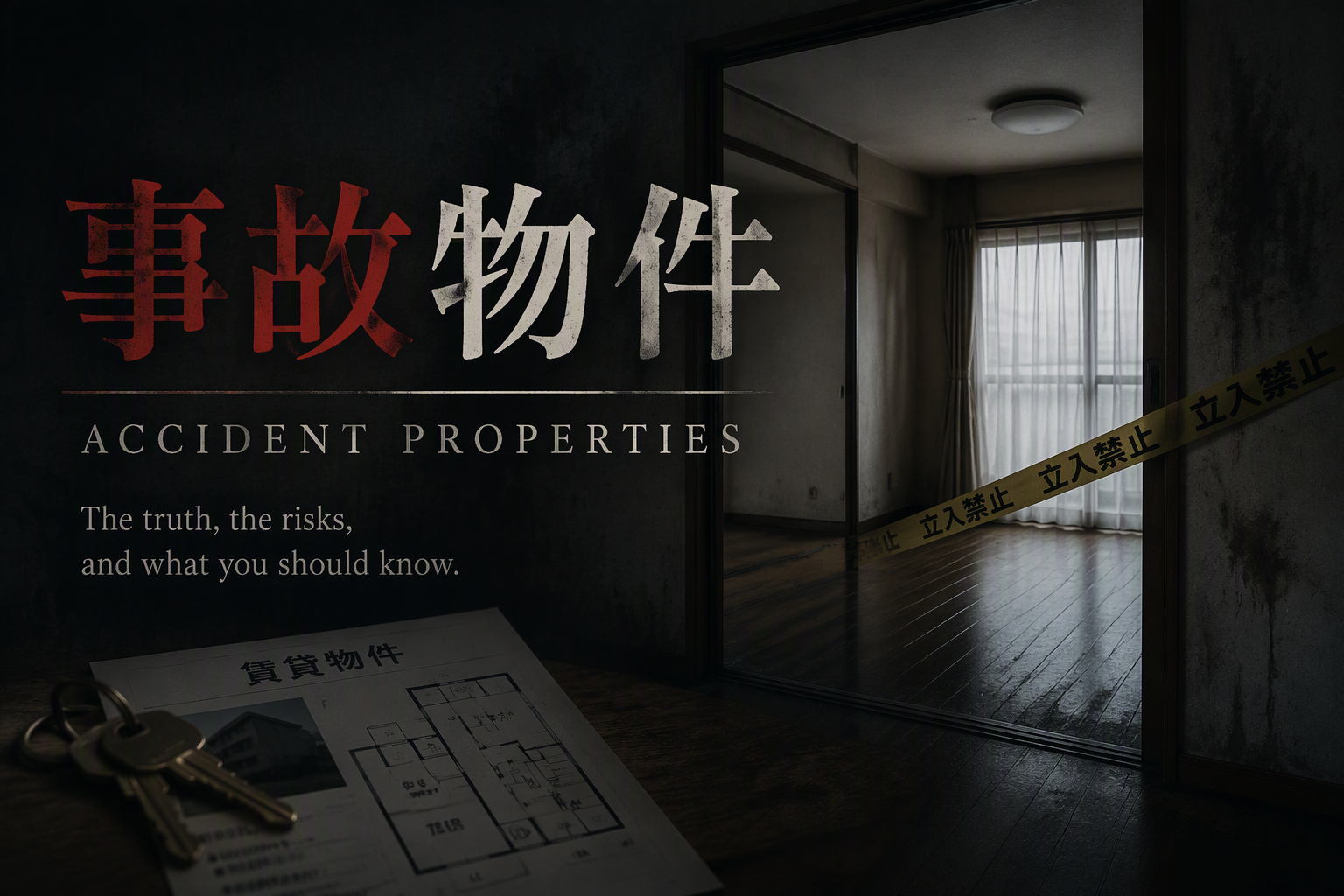
Accident Properties in Japan: The Jiko Bukken Guide
Accident Properties in Japan: Bargain Homes or Buyer Beware?
In Japan, the phrase “accident property” can sound misleading. It rarely refers to a simple mishap. More often, it describes a home or apartment connected to a troubling past: a suicide, homicide, unattended or “lonely” death, fire, or other event that makes future buyers or tenants hesitate. In Japanese, these properties are known as jiko bukken (事故物件), and they occupy a curious space in the real estate market—part legal issue, part cultural taboo, and part potential bargain.
What Is a Jiko Bukken?
A jiko bukken is commonly understood as a property with a “psychological defect” (shinriteki kashi, 心理的瑕疵). Unlike a physical defect, such as a leaking roof or cracked foundation, a psychological defect is invisible. The building may be structurally sound, but its history can make people uncomfortable living there, often leaving the tenant constantly thinking about what occurred, creating a strong sense of unease.
The term is broad. It may include properties where a suicide or murder occurred, homes where a body was left undiscovered for a long period, or places damaged by a serious fire or disaster. Natural deaths and ordinary accidents in daily life are usually treated differently, especially when no special cleaning or unusual circumstances are involved.
Why Are These Properties Stigmatized?
The stigma around accident properties is rooted in both practical concerns and cultural attitudes toward death. Some buyers and renters worry about ghosts, curses, bad luck, or spiritual unease. Popular culture has reinforced this image through horror stories and films, making the idea of a “haunted” apartment easy to imagine. Anyone who has seen the Japanese film “Ju-on” or its American remake “The Grudge” can imagine how films have shaped and reinforced this idea of houses haunted by malcontented malignant spirits.
Yet the discomfort is not always supernatural. Many people are concerned about hygiene, odours, stains, structural damage, neighbourhood safety, resale value, or the possibility that the property will remain difficult to rent or sell in the future. In other words, the fear is often emotional, but the consequences are very real.
What is the Market Impact?
Because many locals avoid jiko bukken, these properties often sell or rent below the market average. Discounts vary widely depending on the severity of the incident, how much time has passed, the location, and whether the property has been renovated. In some cases, rent or sale prices may be reduced substantially to attract tenants or buyers willing to overlook the history.
For sellers and landlords, the stigma can mean extended vacancies and weaker negotiating power. For buyers or renters, however, it can create an opportunity. Those who are less affected by superstition—or who judge the property mainly by price, condition, and location—may find a home that would otherwise be out of reach.
For example, the property that is featured in the video below was on the market for under 18 million yen. It's a 4-bedroom, 2-storey detached/standalone house in Shiga prefecture and was built in 1997. A comparable property in the same area could cost around the same amount, but with one key difference.
Accident Property in Shiga Prefecture
This property has been fully renovated with an updated kitchen, toilets, bathroom, flooring, etc. adding to the overall cost of the property, but from a much lower bar, possibly as low as the land price alone. This is one way that owners of an accident property try to add value to it to make a quick sale to a buyer looking for something both cheap and move-in ready.
What Counts as an “Accident”?
One of the biggest complications is that not every death makes a property a jiko bukken. A natural death from illness or old age generally does not need to be disclosed in the same way, because death at home is not unusual, particularly in an ageing society. Similarly, ordinary accidents connected to daily life (e.g. falling down the stairs) may not automatically create a disclosure obligation.
However, the situation changes when the circumstances are unusual or severe. A suicide, homicide, death connected to a fire, or unattended death requiring special cleaning is much more likely to be treated as a psychological defect. If a body remains undiscovered for a long time, special cleaning may be needed to deodourize the property, remove contamination, and deal with pests. In that case, the property’s history becomes difficult to dismiss as ordinary.
What are Rules and Legal Responsibilities Surrounding Disclosure?
Japan’s real estate industry has long struggled with the question of what must be disclosed and for how long. The Ministry of Land, Infrastructure, Transport and Tourism issued guidelines in 2021 to clarify how deaths in residential properties should be handled. These guidelines helped standardize an area that had previously depended heavily on custom, caution, and individual interpretation.
Real estate brokers are expected to disclose known information that could materially affect a buyer’s or tenant’s decision. They are not generally required to conduct unlimited investigations, but they should ask the owner or management company and must not conceal information they know. Hiding a serious incident because it might discourage a buyer or tenant can lead to major legal and professional consequences, including the rescinding of a real estate licence and of course potential damages to a buyer or tenant.
Disclosure matters because the history of a property can strongly influence whether someone is willing to live there, how much they are willing to pay, and whether they can later resell or rent it smoothly. Transparency protects both sides: buyers and tenants receive information that affects their decision, while sellers and agents reduce the risk of disputes after the contract is signed.
Why Does Murder and Suicide Carry the Strongest Stigma?
Among the different types of accident properties, murder is often the most difficult for buyers and renters to accept. A homicide creates not only psychological unease but also concerns about safety. If such a violent crime occurred in or near the property, people may naturally wonder whether the neighborhood itself is secure.
Suicide also carries a heavy stigma. Some people fear spiritual disturbance or bad luck, while others worry that they would be unable to stop thinking about what happened there. A few may even wonder whether some aspect of the property’s physical environment—such as poor ventilation, dampness, or isolation—contributed indirectly to the tragedy.
How Can I Check Whether a Property Is a Jiko Bukken?
There are online databases and map-based sites that collect information about accident properties, but they should be treated as reference tools rather than definitive proof. Much of the information is user-submitted, so it may be incomplete, outdated, or inaccurate.
The most popular database is Ōshima Terra (大島てる), which includes some information in English, making it a useful resource for foreign buyers of Japanese real estate. However, as mentioned above, much of the information is uploaded by users, so if there is any suspicion that a property may be an accident property, always check with the seller.
The most practical step is to ask the real estate agent directly whether any death, crime, fire, or other serious incident has occurred in the property. Buyers should also read the important matters explanation carefully and look for phrases such as “notice matters” or “psychological defect.” If the price is far below comparable properties in the same area, that can also be a reason to ask more questions, which we would do on your behalf as part of our service.
Japanese Attitudes: More Practical Than Superstitious?

A 2025 survey of 500 Japanese respondents by Wakeari Bukken Kaitori Pro suggests that attitudes towards jiko bukken are more nuanced than a simple refusal. Fewer than one in five respondents said they would absolutely refuse to live in an accident property under any circumstances. Most said their decision would depend on the details.
The strongest reason to consider such a property was financial: 54.2% of respondents said cheap rent would make an accident property more attractive. Other positive factors included the absence of a criminal element and evidence that the property had been cleanly renovated or refurbished.
On the other hand, certain incidents remained major deal-breakers. Murder was the most unacceptable type of accident property, named by 55.0% of respondents, followed by suicide at 21.4%. Fire-damaged properties also ranked highly among concerns, with respondents worrying about the quality of repairs, lingering damage, and the appearance of patched renovations.
These results show that many people weigh accident properties case by case. A violent crime may feel impossible to overlook, but a natural death, a fully renovated interior, or a large rent discount may make the property acceptable to a practical renter.
Are All Accident Properties Horror Stories?
The phrase jiko bukken often brings to mind ghosts, murder, or tragedy, but not every case is so dramatic. Some properties are affected by fires, disasters, or other incidents that create practical concerns rather than supernatural ones. A repaired fire-damaged home, for example, may raise questions about whether renovations were thorough, whether hidden damage remains, or whether the aesthetics feel uneven.
For that reason, buyers should not focus only on the label. The key questions are what happened, how long ago it happened, what repairs or cleaning were carried out, how the event affects future resale or rental demand, and whether the discount adequately compensates for those risks.
Conclusion: A Bargain With Conditions
Accident properties in Japan are not simply “haunted houses” or cheap curiosities. They reveal how culture, law, psychology, and market forces intersect in real estate. For some people, the history of a property is impossible to ignore. For others, especially those focused on price and location, a jiko bukken can be a rational choice.
The best approach is neither fear nor blind enthusiasm, but due diligence. Ask direct questions, check disclosure documents, compare prices, investigate renovation history, and think carefully about resale value. A dark past may lower the price, but it should also raise the buyer’s level of caution.